
Infoconex AI Flywheel Architecture
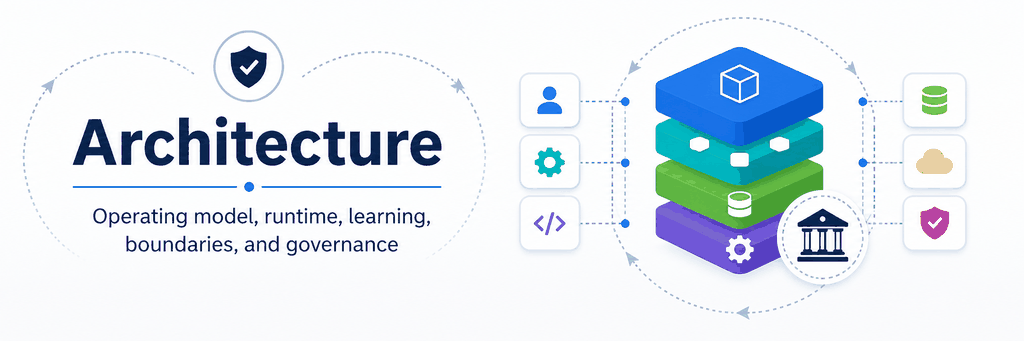
This section explains how the AI Flywheel fits together. It separates the complete operating model, runtime model, post-execution learning model, governance and escalation, and the boundaries that determine where responsibility lives and what the AI is allowed to do.
The diagrams are explanatory views that may evolve with the methodology. They do not define requirements on their own.
Table of Contents
- Core Operating Model — Shows human authority, governance, the three runtime mechanisms, the eight-stage lifecycle, learning destinations, no-change resolution, persistence, reuse, and the core boundaries in one view.
- Runtime Architecture — Shows how the SOP, AI reasoning, and deterministic capabilities work together inside the Execute stage under human-authorized governance.
- Learning Architecture — Shows how execution evidence is observed, evaluated, classified, and used to improve or reinforce future operation.
- Governance and Escalation — Defines governance gates, escalation outcomes, authority versus uncertainty, and the role of the Governance Policy.
- Core Boundaries — Distinguishes the Moving Determinism Boundary from the Authority Boundary and explains how they interact with the Uncertainty Boundary.
Architectural Model
The architecture is easiest to understand through three operating views and two governing concepts:
- Complete operating model: How human authority, execution, evidence, learning, persistence, reuse, and later reevaluation form one system.
- Runtime: How authorized work is performed.
- Learning: How evidence from execution can change the operating state, reinforce an existing validated pattern, or challenge earlier learning.
- Governance: How human-defined authority constrains autonomous action and triggers escalation.
- Boundaries: How the system determines where responsibility belongs, what the AI may do on its own, and when the evidence is not enough for responsible AI judgment.
The three operating mechanisms—deterministic capability, procedural SOP, and AI reasoning—are not sequential lifecycle stages. They work together during execution and become possible destinations for learning after execution.
For the specification, see the Infoconex AI Flywheel Specification. For a practical walkthrough, see the Continuous Dependency Maintenance worked example.