
Infoconex AI Flywheel Conformance
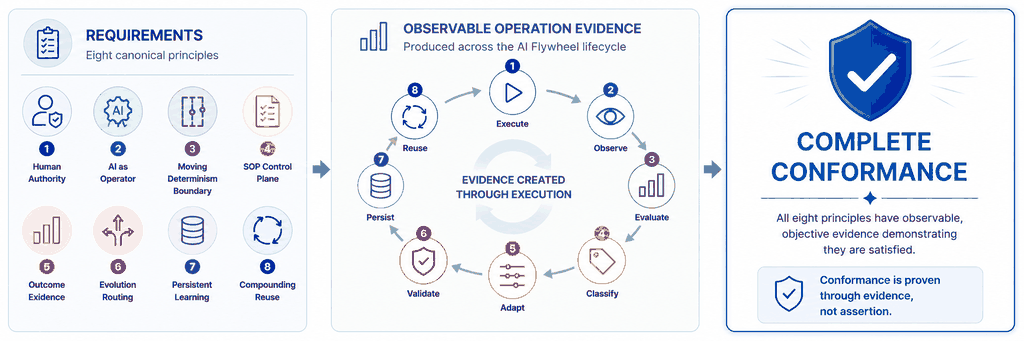
Conformance determines whether an implementation satisfies the complete Infoconex AI Flywheel Specification.
The conformance model does not create a separate set of requirements. The eight canonical Principles provide the top-level conformance structure, while the Lifecycle defines the operational behavior through which those principles are exercised and evidenced. The Formal Definition remains the overall boundary for what constitutes an Infoconex AI Flywheel.
A complete conformance assessment therefore asks whether each canonical principle can be demonstrated through observable evidence from actual lifecycle operation. A system may contain individual AI Flywheel mechanisms without conforming to the complete methodology.
Conformance Model
Conformance follows a simple relationship:
Requirements → Observable operation evidence → Conformance decision
- Requirements — The eight canonical principles define the enduring requirements of the operating model.
- Observable operation evidence — Execution across the lifecycle produces evidence showing how those requirements behave in practice.
- Conformance decision — An implementation conforms only when the complete set of principle requirements is demonstrated through objective evidence and the required lifecycle behavior is present.
This structure keeps conformance aligned with the specification instead of introducing a separate vocabulary of assessment areas.
Assessment Results
Each of the eight principle-aligned assessments must resolve to one of these results:
- Conforms — Sufficient observable evidence demonstrates the applicable normative requirements.
- Does Not Conform — Observable evidence demonstrates that one or more applicable requirements are not satisfied.
- Insufficient Evidence — The available evidence is not sufficient to determine that the requirements are satisfied.
Insufficient Evidence is not a passing result. A complete conformance claim requires sufficient evidence for all eight principles.
An assessor must not infer required behavior solely from architecture labels, diagrams, configured capabilities, documentation, or stated intent. Those sources may explain an implementation, but conformance requires evidence that the required behavior actually operated.
The detailed assessment basis, evidence expectations, pass conditions, and contradictory evidence for all eight principles are defined in Principle-Aligned Conformance Assessments.
Principle-Aligned Assessment
A complete conformance review evaluates each canonical principle using evidence from the lifecycle stages and governance behavior most relevant to that principle.
| Principle | What Must Be Demonstrated | Primary Lifecycle Relationship |
|---|---|---|
| 1. Autonomy Is Bounded by Human Authority | Human-defined authority boundaries govern autonomous operation and persistent change. The AI cannot grant itself additional authority, prohibited actions are blocked, and insufficient evidence or required judgment is escalated appropriately. | Applies before and throughout all lifecycle stages. |
| 2. AI Is the Operator, Not Merely the Assistant | AI performs meaningful operational work and can continue within delegated authority rather than merely producing instructions for a human operator. | Execute |
| 3. Work Is Distributed Across a Moving Determinism Boundary | Deterministic capability, procedural guidance, and AI reasoning have clear and intentional responsibilities, and those responsibilities can move when evidence shows a different placement is more appropriate. | Execute, Classify, Adapt |
| 4. The SOP Is an Operational Control Plane | A durable Standard Operating Procedure (SOP), or equivalent machine-consumable guidance, directs how work is performed, handles known conditions, defines evidence and escalation expectations, and remains subject to governance. | Execute, with later adaptation, persistence, and reuse |
| 5. Execution Must Produce Outcome Evidence | Execution produces enough objective evidence to determine what actually happened and whether the intended outcome was achieved. Success, failure, partial success, and unresolved uncertainty can be distinguished without relying only on model confidence or task completion. | Observe, Evaluate, Validate |
| 6. Failure Determines Where the System Evolves | Outcomes and learning opportunities are classified to determine whether adaptation is justified and where resulting learning should live. Successful outcomes may reinforce validated patterns without requiring change. | Evaluate, Classify, Adapt |
| 7. Learning Must Change a Persistent Operational Asset | Validated and authorized learning changes the durable operating state in a form future operation can use, while later evidence can challenge and supersede learning that is no longer current. | Validate, Persist, with later evidence returning through the lifecycle |
| 8. Improvement Must Compound Through Reuse | Later relevant executions actually use applicable current persisted learning and produce observable evidence that earlier learning influenced later operation. | Reuse, which becomes part of the starting state for the next Execute |
The same evidence may support more than one principle, and a single principle may require evidence from multiple lifecycle stages. The purpose of the mapping is traceability, not to create one-to-one relationships between principles and stages.
Evidence-Based Assessment
A conformance claim must be supported by observable evidence rather than labels, architecture diagrams, or stated intent alone.
Evidence may include:
- Governance policies and authorization records.
- SOPs or other persistent procedural assets.
- Execution traces and tool outputs.
- Outcome observations and evaluation records.
- Classification and improvement-routing decisions.
- Tests and validation results.
- Material human judgments and approvals.
- Persistent changes produced by earlier execution.
- Later executions showing that those changes were reused.
- Evidence that challenged learning was revised, superseded, deprecated, invalidated, rolled back, or retired when required.
Evidence should be attributable enough for a reviewer to determine what happened, why a conclusion was reached, and how the evidence demonstrates the relevant principle requirements.
A capability existing is not the same as the capability operating as required. For example, the existence of an approval mechanism does not demonstrate that required approvals were enforced, stored learning does not demonstrate reuse, and a defined escalation path does not demonstrate that unresolved uncertainty actually triggered escalation.
Conformance is assessed across the behavior of the operating model, not by requiring every individual execution to produce a new persistent change. A verified successful outcome may reinforce an existing validated pattern rather than justify adaptation. The implementation must still demonstrate that evidence is evaluated and classified, and that the lifecycle can adapt, validate, persist, and reuse learning when evidence supports a lasting improvement.
The exact technology used to satisfy the specification may vary. Conformance evaluates required behavior rather than requiring a specific language, framework, model, storage system, or infrastructure platform.
Independent Assessment
The conformance guidance is intended to support substantially consistent conclusions by independent reviewers evaluating the same evidence.
Reviewers should:
- Identify the normative basis for each principle assessment.
- Examine evidence from actual operation rather than relying only on design intent.
- Determine whether the required lifecycle behavior occurred where applicable.
- Consider contradictory evidence and not only evidence selected to support the claim.
- Record a result for each of the eight principles using the defined assessment results.
- Record the evidence basis for the result so another reviewer can understand how the conclusion was reached.
Examples and architecture documentation may help explain an implementation, but they are not normative unless the specification explicitly incorporates their language as a requirement.
Conformance Decision
A system conforms to this version of the Infoconex AI Flywheel Specification when it can demonstrate, through objective evidence from actual operation, that all eight canonical principles are satisfied and that the complete lifecycle behavior required by the specification is present.
When a principle is assessed as Does Not Conform or Insufficient Evidence, the implementation does not have a complete conformance result for this version of the specification.
An implementation may still use valuable AI Flywheel concepts without complete conformance, but it should not be described as a complete conforming implementation.
This version does not define partial or maturity-based conformance levels. A future version may add maturity levels for areas such as autonomy, persistence, self-modification, governance, validation, and escalation. Until then, those levels are not part of the specification.
A conformance claim is an assessment against the published specification. It does not by itself constitute certification, endorsement, approval, or official status granted by the specification author. No certification program is defined by this version of the specification.
Supporting Evaluation Documents
- Principle-Aligned Conformance Assessments — Defines the normative basis, expected observable evidence, assessment condition, and contradictory evidence for each of the eight canonical principles.
- Conformance Evaluation Checklist — Practical questions organized around the eight canonical principles and the lifecycle evidence used to demonstrate them.
- Non-Conforming Patterns — Common patterns that contain useful Flywheel elements but do not satisfy the complete methodology.