
Infoconex AI Flywheel Examples
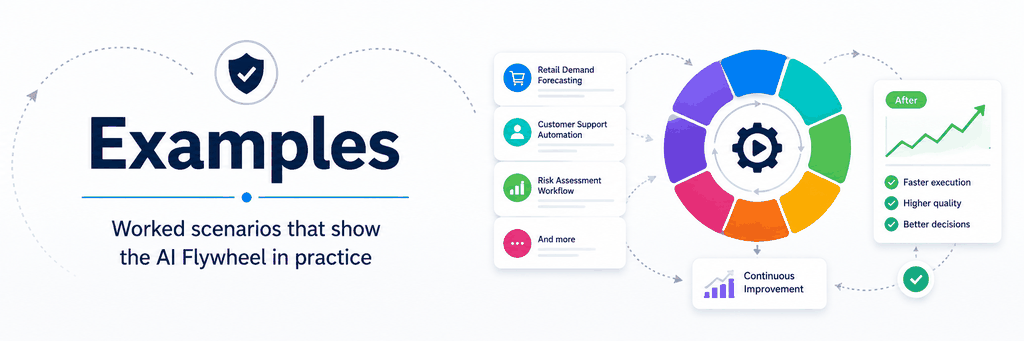
This section contains concrete use cases and end-to-end worked examples showing how the Infoconex AI Flywheel Specification can be applied to real operating processes.
A use case identifies a recurring problem where the AI Flywheel can be applied. A worked example shows how the Flywheel operates that use case through governance, execution, evidence, classification, adaptation when justified, validation, persistence or reinforcement, reuse, and later reevaluation.
A use case may contain several supporting pages when its environment, target state, operating process, and representative scenarios require more detail.
Examples help explain the methodology but do not add new requirements. The requirements remain in the Infoconex AI Flywheel Specification.
Examples
- Continuous Dependency Maintenance — Describes a simulated dependency-health use case and demonstrates how maintenance evidence improves procedure, deterministic capability, and responsibility placement.
- Standards-Driven Repository Modernization — Describes a simulated standards-driven migration use case and demonstrates how repeated repository migrations improve profiles, validation, governance decisions, dependency planning, and deterministic tooling.
Use Cases in Development
- Production Incident Investigation and Recovery — Defines a simulated AI-operated incident-response use case. Its lifecycle worked example will be developed after the use case is reviewed.
- Hypothesis-Driven Problem Solving — Defines a governed test-and-learn use case for problems whose desired outcome is known but whose solution is not. Its lifecycle worked example will be developed after the use case is reviewed.
Example Template
Use the End-to-End Example Template when creating another worked example.
The template standardizes:
- Use-case identification
- Scenario and intended outcome
- Human authorization and governance
- Deterministic capability, procedural guidance, and AI reasoning
- The eight lifecycle responsibilities and their possible transition outcomes
- Successful no-change, failure-derived learning, validation, persistence, supersession, and reuse
- Human-authority outcomes
- Eight-principle conformance mapping
- Evidence of compounding learning and reinforcement
A short example may keep its use case and worked example in one file. A larger example may use a folder containing a use-case package, supporting scenario pages, and a separate worked example.
The template is guidance for documentation consistency. It does not add requirements to the Infoconex AI Flywheel Specification.
How to Read the Examples
A complete end-to-end example should make the following clear:
- What concrete use case is being demonstrated
- What humans authorize
- What the AI operates
- What belongs in deterministic capability
- What belongs in procedural guidance
- What requires AI reasoning
- What outcome evidence is collected
- How outcomes and learning opportunities are classified
- Whether adaptation is justified
- Where resulting learning is routed when change is needed
- How candidate changes or other reusable learning are validated and authorized
- What persists, what reinforces an existing pattern, and what may later be superseded
- How later execution actually reuses the current validated operating state
- What observable evidence supports any conformance mapping
The purpose is not to require one implementation architecture. It is to show how the parts of the specification work together in practice.